

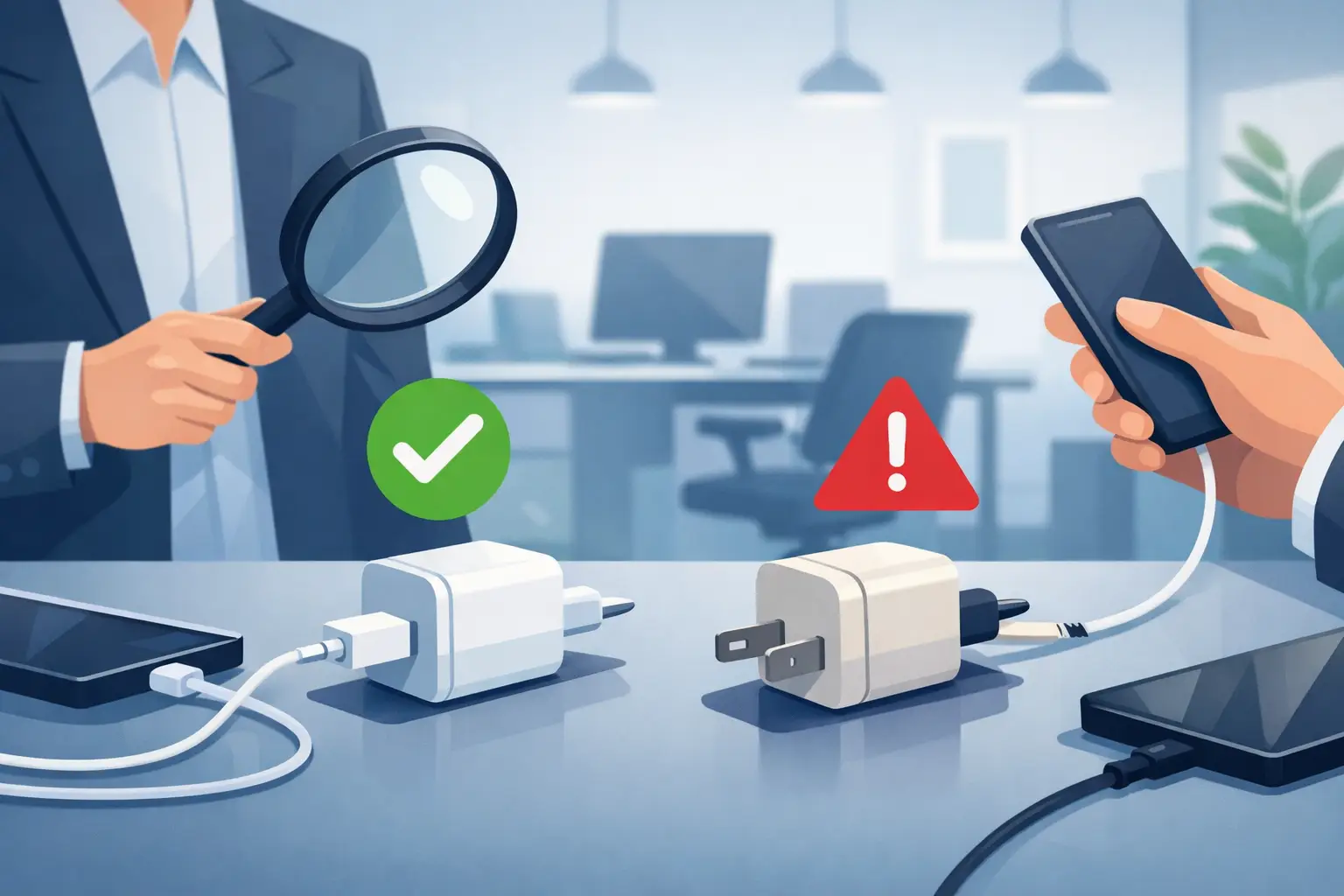
How to Identify Counterfeit Chargers at Work

A charger that looks almost identical to the genuine article can still create a serious fire or electric-shock risk. Knowing how to identify counterfeit chargers is therefore not just useful purchasing knowledge for a workplace - it is a practical part of controlling electrical risks in offices, schools, care settings, holiday lets and managed premises.
The problem is not limited to obvious imitation phone chargers bought from an unfamiliar online seller. Counterfeit and lookalike USB plugs, laptop power supplies, battery chargers and multi-port charging hubs can enter a premises through staff purchases, replacement orders, guest use or equipment supplied with second-hand items. Some work at first. That does not mean they are safe.
Why counterfeit chargers are a workplace concern
A genuine charger is designed with insulation, separation distances, components and temperature limits intended to keep dangerous mains electricity away from the low-voltage output. A counterfeit product may copy the casing and branding while cutting corners inside. Poor soldering, undersized components, inadequate insulation and missing protective parts are all risks found in unsafe chargers.
The consequences can be immediate, such as a painful electric shock from a damaged lead or exposed live part. Others develop slowly: a plug overheats behind a desk, a charging hub discolours a socket outlet, or a battery is repeatedly charged with an unsuitable power supply. These faults can cause equipment damage, smoke, fire and avoidable disruption to your operation.
For duty-holders, the issue is also about evidence. If chargers are brought into use without a sensible purchasing process, visible inspection or asset record, it becomes much harder to show that electrical safety risks have been properly managed.
How to identify counterfeit chargers before they are used
No single sign proves that a charger is fake. Counterfeiters can reproduce logos, packaging and compliance markings convincingly. The safest approach is to consider where it came from, whether its construction is credible and whether anything about its performance or condition gives cause for concern.
Start with the source and the price
The purchase route matters. Products bought directly from a manufacturer, recognised retailer or approved business supplier are generally lower risk than items bought through an unknown marketplace seller, social-media advert or temporary pop-up site. Be cautious where the seller has no verifiable business details, product information is vague, or the listing uses stock photographs only.
An unusually low price should prompt questions, particularly for branded laptop adaptors and high-power USB-C chargers. A discount alone does not make a product counterfeit, but a charger sold for a fraction of the normal price may not contain the safety features expected of the original.
For business use, keep an invoice or order record that identifies the supplier, model and date of purchase. This supports traceability if a product is later subject to a manufacturer recall or safety alert.
Check the plug, casing and markings closely
A formal visual inspection is often the point at which concerns become clear. Look for poorly moulded plastic, rough seams, gaps around pins, loose parts, sharp edges, rattling components or a casing that feels unusually light or flimsy. A genuine product can still fail, but poor build quality is a clear reason to remove a charger from service.
On a UK mains plug, the pins should be straight, secure and correctly proportioned. The live and neutral pins should be partly insulated. The earth pin on a plastic-bodied charger may be plastic, but it must still operate the socket shutter correctly. Any bent pin, cracked plug body, missing pin insulation or damaged cable calls for immediate withdrawal from use.
Markings deserve scrutiny, but should not be treated as proof of safety. A CE or UKCA mark can be copied. Spelling errors, unclear printing, missing model numbers, implausible ratings and labels that rub off easily are warning signs. Check that the input rating is suitable for UK mains supply and that the output rating makes sense for the intended device.
A charger with a detachable mains lead should have the correct type of lead and plug fitted. Do not assume an adaptor makes an overseas charger suitable for workplace use. Travel adaptors are not a permanent substitute for correctly specified equipment, and poor-quality adaptors can introduce their own overheating and contact risks.
Watch for heat, noise and unreliable charging
Chargers may become warm during normal use, especially when fast-charging a tablet, laptop or power tool battery. Excessive heat is different. A charger that is too hot to touch comfortably, smells of hot plastic, buzzes, crackles, repeatedly disconnects, charges unusually slowly or causes a device to become excessively hot should be unplugged and quarantined.
Do not continue using it just because it still charges. Intermittent performance can indicate poor internal connections or failing components. Equally, do not cover a charger under papers, bedding, soft furnishings or clothing, where normal heat cannot dissipate.
A useful workplace rule is simple: if a charger behaves differently from an equivalent known-good unit, treat it as suspect until checked. Record the item, its user and the observed issue so that it is not returned to circulation by mistake.
What PAT testing can and cannot reveal
Portable Appliance Testing is more than applying a pass sticker. A competent inspection can identify damage, unsuitable plugs, incorrect fuses, poor cable strain relief, overheating evidence, unsafe adaptors and products that do not appear suitable for their claimed purpose. Electrical tests, where appropriate for the appliance type, can also identify faults that a visual check cannot reveal.
However, PAT testing cannot always authenticate a charger or guarantee the quality of hidden internal construction. A counterfeit charger may pass a limited electrical test on the day yet still use inadequate internal clearances or components that fail under prolonged load. That is why inspection should be combined with sensible procurement, recall checks, review of known unsafe or lookalike products, and a clear process for removing suspect equipment.
The type of charger matters too. Many modern USB chargers are Class II, double-insulated appliances with no earth connection, so the most relevant checks differ from those applied to an earthed appliance. A qualified engineer should select the appropriate inspection and test process rather than rely on a one-size-fits-all approach.
A practical response when a charger is suspected
Do not open a charger to investigate it. Even unplugged equipment may contain components that store electrical energy, and opening the casing can destroy useful evidence. Unplug it from the mains, label it clearly as not for use and keep it separate from serviceable equipment.
Then establish where it came from and whether other identical units are in use. Check the supplier record, model number and any manufacturer or product-safety recall information. If the charger was supplied with workplace equipment, contact the supplier rather than replacing it with an unverified alternative.
Where there has been heat damage, smoke, a tripped circuit, a shock or signs of arcing, the associated socket outlet and lead should also be checked. The fault may be in the charger, but the incident can expose damage elsewhere in the installation or extension lead.
If a suspected item is confirmed unsafe, dispose of it through an appropriate electrical waste route. It should never be passed to another department, sold on or placed in a staff giveaway box.
Prevent counterfeit chargers entering your premises
The strongest control is a simple, proportionate policy. Provide approved chargers for shared devices and business-critical equipment. Specify that replacements must be bought through approved suppliers. Ask staff to report damaged, unusually hot or unlabelled chargers rather than quietly substituting them.
For managed accommodation, education and care environments, consider how guest, resident or student equipment is handled. You may not be able to inspect every personal charger in advance, but you can give clear guidance, respond quickly to concerns and prevent unsafe items being used with supplied extension leads or charging stations.
An up-to-date asset register makes this process easier. Recording chargers alongside laptops, tools and other portable appliances gives managers a clearer picture of what is on site, where it is used and when it was last inspected. Electrotech Services incorporates item registration, inspection findings and documented corrective actions into its PAT testing process, helping duty-holders deal with risks before they become an incident.
A charger is a small item, often overlooked until it fails. Treating its source, condition and use as part of everyday electrical safety is a straightforward way to protect people, premises and the continuity of your work.


